
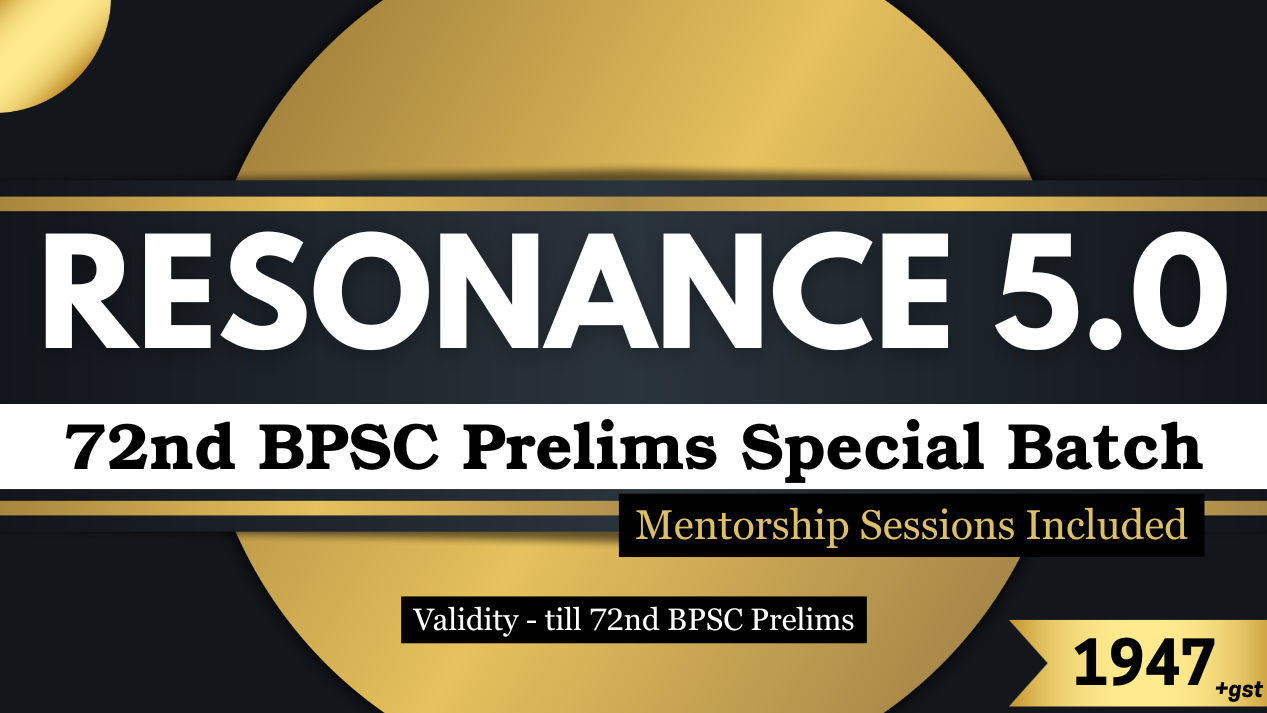
Resonance 5.0
Product information
- Number of chapters
- 112 Chapters
- Number of contents
- 328 Contents
Resonance 5.0 Is Comprehensive Prelims Programme for the 72nd BPSC Prelims Course Duration: 16th February 2026 to 31st May 2026 Course Fee: ₹1,947/-
If you have ever studied in Resonance, Daksh or Essay batches in BCW. You will get Resonance 5.0 Pro at just 1947+GST
Resonance 5.0
Resonance 5.0 Is Comprehensive Prelims Programme for the 72nd BPSC Prelims, built for aspirants who do not want random preparation, scattered notes, or last-moment panic. This is the 5th batch of the Resonance series shaped through years of real classroom execution and consistent offline test operations in Patna and Delhi. Over the last three years, BCW has developed a robust Prelims ecosystem that students trust for one simple reason: the focus remains fixed on what actually matters in the exam syllabus relevance, conceptual clarity, and MCQ performance.
Resonance 5.0 is designed to take a student from “I am preparing” to “I am test-ready.” It offers a time-bound academic journey where the syllabus is not treated as a checklist, but as a structured pathway. The course emphasises clarity in core subjects, Bihar-specific readiness, and the ability to solve MCQs with speed and accuracy because Prelims is not about reading more, it is about performing better under exam conditions. Along with classroom teaching, the course is supported by regular PYQ alignment and practice integration so that students develop the habit of thinking in a Prelims pattern from the beginning not at the end.
The syllabus coverage is comprehensive and Prelims-oriented: Indian Polity, History, Geography (including map-based coverage), General Science (Physics, Chemistry, Biology), Bihar Special, Economy, and Mathematics/Mental Ability. The programme runs on a disciplined weekly routine with Monday to Saturday classes, while Sundays are reserved for consolidation revision, PYQ practice, doubt resolution, backlog clearance, and faculty interaction sessions where students receive guidance on preparation strategy, common mistakes, and performance improvement.
Resonance 5.0 is suitable for students who want:
- A clear roadmap instead of confusion about “what to study and what to leave”
- Exam-focused teaching that remains aligned with BPSC Prelims demand
- Consistency and discipline through a fixed academic schedule
- A preparation environment that pushes them towards accuracy, speed, and confidence
Course Duration: February 2026 to 31 May 2026 (planned completion on or before this date)
Course Fee: ₹1,947/-
Resonance 5.0 (72nd BPSC Prelims): Course Structure
- Commencement: February 2026
- Syllabus Completion: 31 May 2026 (or earlier)
- Mode: Online Classroom programme with a structured weekly schedule and included Mentorship sessions
Teaching Model:
Resonance 5.0 follows a Learning Model, where you study 2 to 3 subjects simultaneously to ensure continuity and balance. As soon as a subject completes its planned coverage, the next subject is introduced, so the course progresses without interruptions.
This ensures:
- Consistent study momentum throughout the programme
- Timely completion of all subjects within the planned timeline
- Smooth transition from subject coverage to practice and testing
COURSE TIMELINE
|
Plan |
|
When Polity ends → Chemistry starts When Geography ends → Physics starts When History/Chemistry end → Biology / Bihar start Economics and Maths Continues thereafter |
|
Revision + PYQ + backlog + Faculty Interaction |
||
SUBJECT FLOW
Phase 1: Core buildup (Course Start)
- Polity + History + Geography are initiated together in parallel.
Phase 2: Broaden Base (As subjects complete)
Deliverables:
- Subject wise lecture : Recorded/Live
- Modular Tests
- Subject wise Homework as MCQ from ASTRA
- Atleast 1 Interaction with Faculty/Mentors per week
Subjects to be covered
Indian Polity
- Constitutional evolution & making of the Constitution
- Salient features, Preamble, basic structure doctrine
- Citizenship, Union & its territory, amendment procedure
- Fundamental Rights, DPSPs, Fundamental Duties
- Union government: President, Parliament, PM–CoM
- State government: Governor, CM–CoM, State Legislature
- Judiciary: Supreme Court, High Courts, lower judiciary; writs & judicial review
- Federalism & Centre–State relations (including financial relations)
- Emergency provisions
- Election system & electoral reforms; Election Commission
- Local governance: Panchayats & Municipalities; State Election/Finance Commission
- Constitutional & non-constitutional bodies
History
Ancient India
- Prehistoric cultures, Indus Valley civilisation, Vedic age
- Rise of states & empires (Mahajanapadas, Magadha, Mauryas, Guptas and key phases)
- Jainism & Buddhism; major developments in society, economy, polity
Medieval India
- Early medieval patterns & regional kingdoms
- Delhi Sultanate, Bhakti–Sufi movements
- Mughal Empire (administration, policies, culture) and its decline
- Deccan & South India (major kingdoms and broad developments)
Modern India
- Advent of Europeans, consolidation of British rule
- Economic impact of British rule; major administrative/economic policies
- Socio-religious reform movements
- Revolt of 1857 (including Bihar linkage)
- National movement (Moderate–Extremist–Gandhian), revolutionary trends, INA
- Post-1947: integration and constitution-making (broad overview)
Geography
Physical Geography
- Earth structure, landforms, plate tectonics; geomorphic processes
- Atmosphere & climate basics: circulation, monsoon system, cyclones; El Niño/La Niña
- Oceanography: currents, tides, EEZ; marine resources
Indian Geography
- Physiographic divisions; location & time concepts
- Climate of India; river systems; soils; natural vegetation & wildlife
- Natural hazards in India; agriculture & irrigation; industries and location factors
World/Economic Geography
- Continents/oceans; climatic zones & natural regions
- Latitude–longitude/time zones; basic map work & key global hotspots
- Resources: energy, water, minerals (distribution themes, broad mapping awareness)
Economy
- Basic concepts: national income aggregates (GDP etc.) and core indicators
- Inflation/deflation and policy control
- Budget & fiscal concepts
- Money & banking basics (RBI, banking functions, key monetary tools)
- Planning approach in India (Five Year Plans → NITI Aayog) and reform overview (LPG)
- Union and Bihar Economic Survey
- Union and Bihar Budget
General Science
Physics
- Mechanics & daily-life applications (motion, force, work, energy, machines)
- Heat & thermodynamics basics (temperature, transfer, expansion)
- Sound & light basics (reflection/refraction; lenses/mirrors; common instruments)
- Electricity & magnetism basics (circuits, safety, electromagnetism)
- Modern physics basics (radioactivity, nuclear energy, semiconductors, lasers)
Chemistry
- Matter & atomic structure; periodic table trends
- Chemical reactions; acids–bases–salts
- Metals/non-metals; alloys; corrosion and prevention
- Carbon compounds (hydrocarbons, alcohols, polymers/plastics) + environmental impact
- Environmental chemistry basics (pollution themes; ozone/green chemistry awareness)
Biology
- Cell biology (cell structure, organelles, cell division)
- Human physiology (major systems in broad)
- Plant physiology (nutrition/photosynthesis, transpiration, hormones)
- Genetics & biotechnology basics (DNA/RNA, heredity, vaccines awareness)
- Health & diseases (communicable/non-communicable, immunity, nutrition, public health)
Bihar Special
- Bihar history & heritage (ancient–medieval–modern themes; key personalities/movements)
- Bihar geography (physiography, rivers, soils/agriculture, disasters)
- Bihar polity & governance (state administration basics, local governance)
Maths + Mental Ability (Quant + Reasoning)
- Arithmetic fundamentals (number system, simplification, percentage/ratio, SI–CI, averages)
- Time–work; time–speed–distance; mensuration basics (2D/3D)
- Algebra and geometry basics; trigonometry basics
- Statistics and data interpretation (tables/graphs, averages; basic probability awareness)
- Reasoning: verbal, non-verbal, logical reasoning; simple puzzles/arrangements